Three ways to invest in Thrivent funds

We’re here to help you invest with confidence.

MUTUAL FUNDS

Thrivent Account

You can purchase mutual funds right on our site with an online account.

Invest with a Thrivent account

  • Set up an account starting with as little as $50 per month.1
  • Access your online account at your convenience.
  • Purchase funds without transaction fees or sales charges.

MUTUAL FUNDS & ETFS

Financial Professional

For guidance when investing, ask a financial professional about investing in Thrivent mutual funds & ETFs.

Invest with a financial professional

  • Receive investment help from an experienced professional.
  • Build a relationship through in-person meetings.
  • Get help planning for life’s goals such as saving and retirement.
  • Additional fees may apply.

MUTUAL FUNDS & ETFS

Brokerage Account

If you already have a brokerage account, our mutual funds & ETFs can be purchased through online brokerage platforms by searching for Thrivent Mutual Funds and ETFs.

Invest with a brokerage account

  • Add Thrivent Mutual Funds and ETFs to your investments within your existing portfolio.
  • Take advantage of your account to keep your investments in one place.
  • Additional fees may apply.

Not quite ready?

We want you to invest your money wisely and with confidence.
Here are some other options that may help you.

  • Take our quiz to determine your personal investment style.
  • Talk to your financial advisor about ETFs.
  • Sign up for our monthly investing insights newsletter.


Need more help?

If you need assistance, we’re here to help. Reach out to us via the phone, email, and support page information below.


1 New accounts with a minimum monthly investment amount of $50 are offered through the Thrivent Mutual Funds “automatic investment plan.” Otherwise, the minimum initial investment requirement is $2,000 for non-retirement accounts and $1,000 for IRA or tax-deferred accounts, minimum subsequent investment requirement is $50 for all account types. Account minimums for other options vary.

Thrivent ETFs may be purchased through your financial professional or brokerage platforms.

Contact your financial professional or brokerage firm to understand minimum investment amounts when purchasing a Thrivent ETF.

Now leaving ThriventFunds.com


You're about to visit a site that is neither owned nor operated by Thrivent Mutual Funds.

In the interest of protecting your information, we recommend you review the privacy policies at your destination site.

MUTUAL FUND FOCUS

Understanding mutual funds


Key points

Target date funds

It’s important to understand the strategy behind a target date fund’s approach.

Target risk funds

Use target risk funds to build a mix of stocks and bonds that align to a particular risk level—aggressive or conservative.


Like many investors, you may rely on mutual funds to help make your money work for you. And, investing in a mix of stocks and bonds within a single mutual fund can help keep investments diversified.

The two most popular types of all-in-one mutual funds are target date funds and target risk funds. Though their investment philosophies differ, both are designed to help you realize your investment goals in a convenient way.

Investing Insights newsletter

Subscribe to receive tips to help navigate your financial journey and ideas for setting and reaching your goals.

Target date funds

Target date funds offer an easy way to diversify investments. Simply select a mutual fund based on the year you plan to retire, and the fund automatically adjusts over time to stay in line with your investment goals.

You don’t need to rebalance or select underlying funds—the single target date fund does that for you. The mix of assets within your account gradually shifts from an aggressive to a more conservative risk profile as the target date approaches.

Target date funds may seem a good solution, but investors should be aware, the funds aren’t always as hands-off as they may appear when strategizing them into a portfolio. It’s important to determine if a fund is too aggressive or conservative for your individual risk tolerance.

Target risk funds

Target risk funds build a mix of stocks and bonds that align to a particular risk level:

  • An aggressive target risk fund may put 75% to 100% of its assets into stocks (with the remaining assets in bonds).
  • A conservative target risk fund may have the opposite asset mix (nearly all bonds with limited stock holdings).

Generally, younger investors will put their money into more aggressive target risk funds and focus on growing their assets. Older investors tend to use more conservative target risk funds to help protect their assets as retirement grows closer.

No matter what your planned retirement age is, you can get the right investment mix with a target risk fund based on your risk profile. You can also update it as your investing needs evolve. Keep in mind, you will be responsible for adjusting your investments as your risk tolerance changes.

Understanding mutual fund performance

Looking at how a fund has performed is one of many important considerations when selecting investments. The mutual fund industry adheres to strict standards when publishing or providing mutual fund portfolio performance data. The intent is to provide fair and balanced information when potential investors compare various options. If you know what to look for, you can quickly size up different funds and find one that’s right for you. Keep in mind that past performance is not indicative of future results, but seeing how a fund has performed over time may help provide some insight into how it historically has been managed.

Mutual fund performance indicators

Here are some of the typical values used to determine fund performance:

Net asset value (NAV)
The NAV is the fund’s value or price per share. The NAV is calculated by dividing the total value of all the fund’s assets (minus its liabilities) by the number of shares issued. NAVs are only calculated once per day, after the market has closed.

Daily NAV change
Since mutual funds are only priced once a day, the daily NAV change is the difference between the fund’s most recent price per share and its price from the prior day. The daily NAV change can be shown as a dollars-and-cents change or a percentage change.

Returns
Mutual fund performance is usually presented as a total return. Total returns include both the fund’s change in value and the reinvestment of any dividends, capital gains or interest payments.

Average annualized or trailing returns
Average annualized returns, also known as trailing returns, illustrate fund performance over a specific time period, usually looking backward from a recent month or quarter-end. The most common time periods include three months, year-to-date, 1 year, 3 year, 5 year, 10 year and since inception.

Calendar year returns
Mutual funds will also often show calendar year returns which illustrate how a fund performed from January 1 to December 31 of that particular year. This allows you to see how the fund performed during specific historical time periods.

Growth of a $10,000 investment
Below is an example of a chart many mutual funds present to demonstrate how a $10,000 investment in that fund would’ve changed over time. These charts typically go back either 10 years or back to the initial launch of the fund.

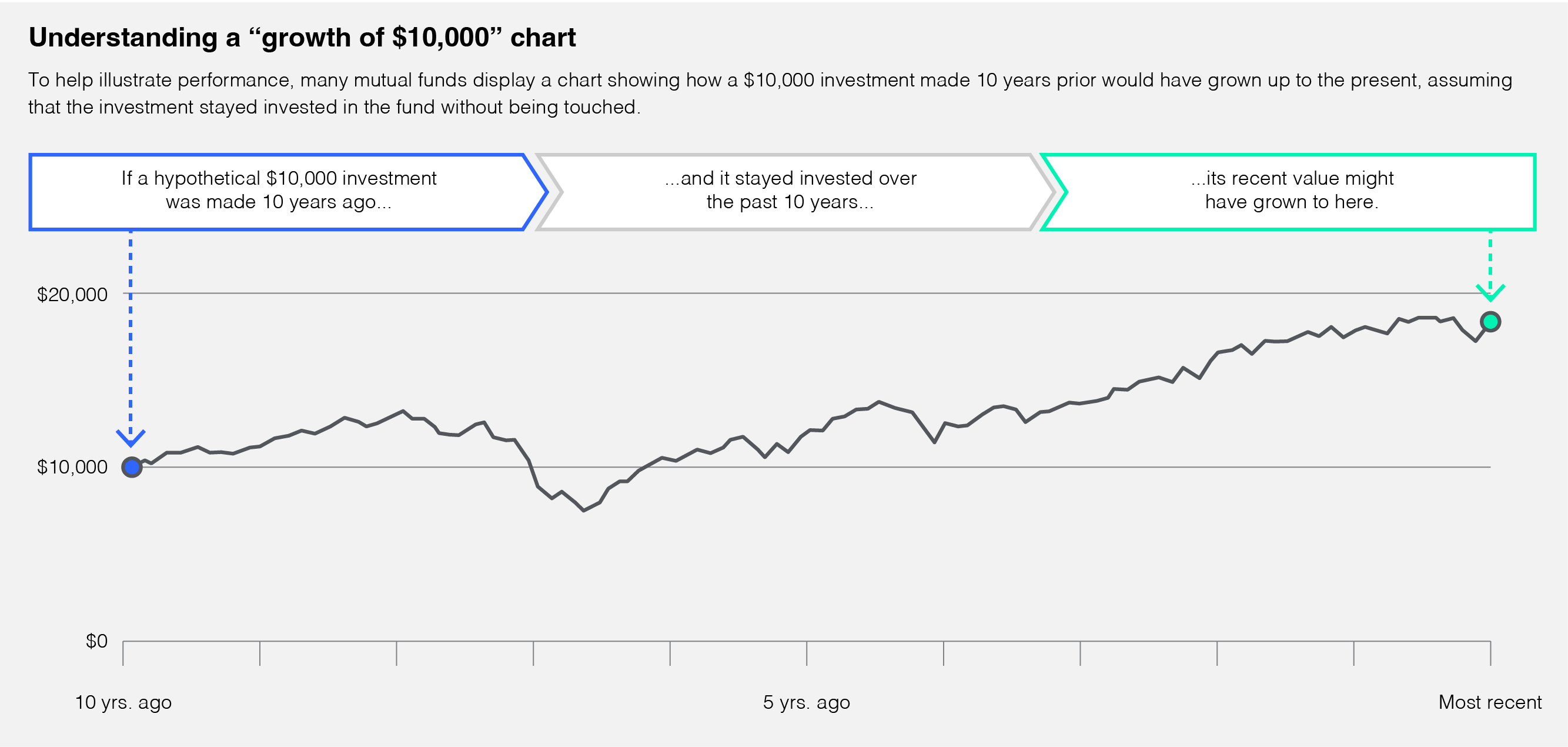
This chart illustrates a hypothetical example of how a $10,000 investment made 10 years ago would have increased in value, assuming the investment stayed in a fund without making any changes to it.

Hypothetical example is for illustrative purposes only.

Understanding fees and expenses of mutual funds

Fund expenses cover the investment and day-to-day operating costs of the fund. Depending on the fund company’s policies and the structure of the funds themselves, fees and expenses may extend to cover additional costs, like marketing expenses for the fund.

Here’s a list of the common fees and expenses associated with mutual funds, although not all fees apply to all funds:

  • Fund operating expenses
    These expenses are frequently expressed as a fund’s expense ratio, which is how much a mutual fund charges its shareholders by percentage per year. A good rule of thumb is the lower the ratio, the lower the operating costs passed on to shareholders. The different types of fees included in the expense ratio are:
    • Management fees
      These cover the day-to-day management of a fund by portfolio managers and research analysts, who monitor the portfolio and make investment decisions. These fees may vary as some funds are more expensive to run due to the nature of the fund’s focus. For example, it typically costs more money to research smaller emerging markets stocks than it does to research large U.S. stocks. Stock funds are generally more expensive than bond funds. Actively managed funds are often more expensive than index funds. 
    • Distribution/12b-1 fees
      Some funds may have an annual marketing or distribution fee, generally 0.25–1% of the fund’s net assets.
    • Other expenses
      Fees which cover other costs of operating the fund including fees for legal, accounting, record keeping and other administrative costs. 
  • Sales loads or charges
    When you buy mutual fund shares, there’s often a broker or other intermediary party who helps the fund company sell the fund. The sales load (a percentage of the purchase) is how these intermediaries receive compensation. There are two common ways sales loads are structured:
    • Front-end load 
      This sales charge is applied at the time of an initial purchase of mutual fund shares. When a front-end load is paid, the public offering price (POP) is higher since it reflects the sales charge, so you purchase fewer shares than if you purchased at the net asset value price (NAV).
    • Back-end load 
      This fee is paid when selling shares in a mutual fund within a defined time period, often five–10 years. The fee amounts to a percentage of the value of the shares being sold. The fee percentage is highest in the first year and decreases yearly until the specified holding period ends, at which time it drops to zero.

Funds will charge either the front-end, or the back-end load, but not both. Since these two sales loads are a one-time fee and specific to the size of the purchase or sale, they aren't reflected in a fund’s expense ratio. 

  • Redemption fees
    Some funds charge a fee for withdrawing money from a mutual fund account within a set number of days after making a purchase. These fees are usually used to discourage shareholders from making too many round trips (purchases followed by a redemption) in a short period of time. 
  • Transaction fees
    Transaction fees are charged by a broker or other intermediary for providing assistance in purchasing or selling shares of a fund. These fees can be charged up-front or when selling the shares.
  • Low balance fees
    When the balance of an account falls below a certain level, some funds charge a low balance fee to cover the higher costs associated with maintaining small accounts.
  • Annual retirement custodial fees
    A flat fee charged by a bank or brokerage for administering or managing an IRA/retirement plan.
  • Overnight or wire fees
    A fee charged by a broker or transfer agent for sending money using an expedited service for delivery of the assets.

Mutual funds at Thrivent Asset Management

When you choose to invest in mutual funds at Thrivent Asset Management, we try to keep the fees and expenses low, and as clear and simple to understand as possible. Here’s a list of the fees and expenses you can expect:

Class S Shares refers to Thrivent Mutual Funds – Class S Shares

Class A Shares refers to Thrivent Mutual Funds – Class A Shares (not available for purchase on thriventfunds.com but available for purchase through a financial professional.)

Distribution/12b-1 fees
  • Class S Shares – None
  • Class A Shares – None – 0.25%1
Annual fund operating expenses
  • Class S Shares
    • Gross: 0.32% – 1.58%
    • Net: 0.45% – 1.04%
  • Class A Shares
    • Gross: 0.36% – 1.52%
    • Net: 0.32% – 1.22%
  • Some funds may have expense waivers. See the appropriate fund detail page or the expense table in the prospectus for more information.
Front-end charges
  • Class S Shares – None
  • Class A Shares – 0% – 4.50%1
    Note: The more you invest, the lower the sales charge per the breakpoint schedule. For more information on how to reduce sales charges, see sales charges.
Redemption fees
  • All share classes – None

Transaction fees
  • All share classes – Fees are not charged by Thrivent Mutual Funds including transactions completed through thriventfunds.com. If a broker/dealer assists you, they may charge fees.
Low balance fee 
  • All share classes – $10 semiannual fee if account balance falls below minimum levels. The low balance fee does not apply to automatic investment plan accounts. See the prospectus for more details.
Back-end charges
  • All share classes – None
Annual custodial fees
  • $15 fee to cover the additional expense for maintaining a retirement plan.
  • Annual fee based on type of retirement plan. Typically taken in December, will be applied to accounts held by clients with aggregate balances below $50,000. Fees also waived for clients with an automatic purchase plan for $3,000 or more annually. Retirement plan groups consist of: 
    • Traditional IRA, Roth IRA and SEP IRA
    • 403(b)
    • Simple IRA
    • Coverdell Education Savings Account (CESA)
  • When closing all accounts in that retirement plan group, the $15 fee is taken from the last account of that plan group when all shares are redeemed.
Overnight or wire fees 
  • Expedited delivery fee will be charged upon shareholder request for redemption proceeds to be sent via overnight express mail or wire transfer to a bank account.

At Thrivent Asset Management, we offer a wide range of target risk funds in our Asset Allocation funds. Our team of seasoned investment professionals brings deep knowledge and thorough research to actively manage each fund.

Look into the well-researched and convenient investment options at Thrivent Asset Management to help make investing easier.


The concepts presented are intended for educational purposes only. This information should not be considered investment advice or a recommendation of any particular security, strategy, or product.

1 For a full breakdown of distribution/12b-1 fees and front-end charges for Thrivent Mutual Funds – Class A shares, please see the prospectus.


Your retirement investment journey begins with 3 steps

Take advantage of tax contribution limits and open a Thrivent Mutual Funds IRA today. Choose an account, select mutual funds that match your retirement goals and investing style, and open your account.


Related Insights