Three ways to invest in Thrivent funds

We’re here to help you invest with confidence.

MUTUAL FUNDS

Thrivent Account

You can purchase mutual funds right on our site with an online account.

Invest with a Thrivent account

  • Set up an account starting with as little as $50 per month.1
  • Access your online account at your convenience.
  • Purchase funds without transaction fees or sales charges.

MUTUAL FUNDS & ETFS

Financial Professional

For guidance when investing, ask a financial professional about investing in Thrivent mutual funds & ETFs.

Invest with a financial professional

  • Receive investment help from an experienced professional.
  • Build a relationship through in-person meetings.
  • Get help planning for life’s goals such as saving and retirement.
  • Additional fees may apply.

MUTUAL FUNDS & ETFS

Brokerage Account

If you already have a brokerage account, our mutual funds & ETFs can be purchased through online brokerage platforms by searching for Thrivent Mutual Funds and ETFs.

Invest with a brokerage account

  • Add Thrivent Mutual Funds and ETFs to your investments within your existing portfolio.
  • Take advantage of your account to keep your investments in one place.
  • Additional fees may apply.

Not quite ready?

We want you to invest your money wisely and with confidence.
Here are some other options that may help you.

  • Take our quiz to determine your personal investment style.
  • Talk to your financial advisor about ETFs.
  • Sign up for our monthly investing insights newsletter.


Need more help?

If you need assistance, we’re here to help. Reach out to us via the phone, email, and support page information below.


1 New accounts with a minimum monthly investment amount of $50 are offered through the Thrivent Mutual Funds “automatic investment plan.” Otherwise, the minimum initial investment requirement is $2,000 for non-retirement accounts and $1,000 for IRA or tax-deferred accounts, minimum subsequent investment requirement is $50 for all account types. Account minimums for other options vary.

Thrivent ETFs may be purchased through your financial professional or brokerage platforms.

Contact your financial professional or brokerage firm to understand minimum investment amounts when purchasing a Thrivent ETF.

Now leaving ThriventFunds.com


You're about to visit a site that is neither owned nor operated by Thrivent Mutual Funds.

In the interest of protecting your information, we recommend you review the privacy policies at your destination site.

INVESTING ESSENTIALS

Choosing between stock and bond investments

05/12/2026

05/12/2026

The world of investing is finding the balance of where to invest with your risk tolerance, return desires and timing needs so you can work toward achieving your investing goals. There are many ways to diversify your portfolio to match your financial needs, time horizon, risk tolerance and investing goals.

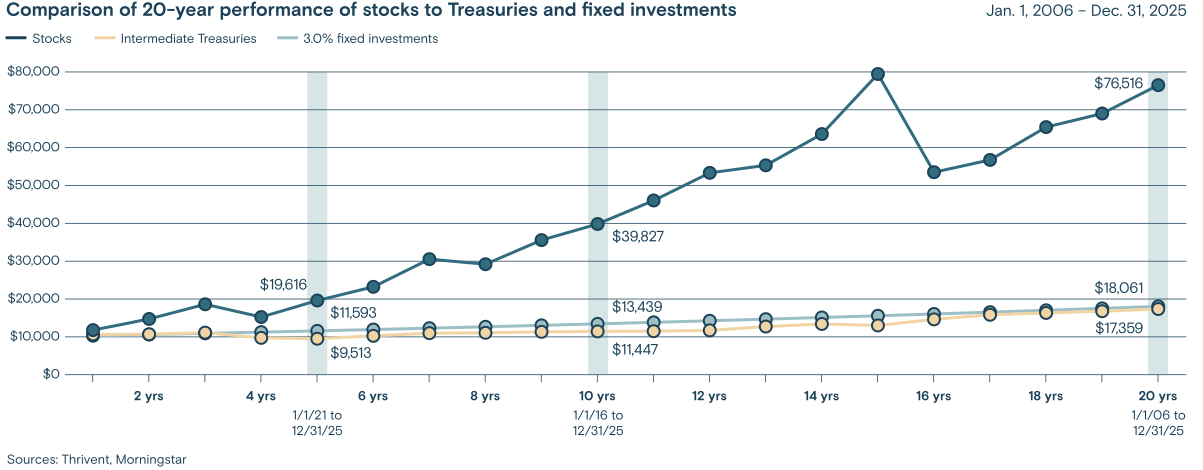
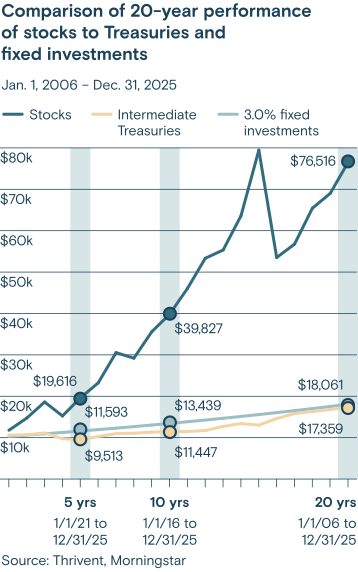
While any asset class can have the best performance in any given year, history has shown that stocks tend to outperform bonds as well as other fixed investments. There may be volatility over time, but in the long run, stocks are most likely to outperform other asset groups.

The following chart shows the comparison between stock and Treasury bond returns over the past 20 years. It assumes an initial investment of $10,000:

Chart comparing the performance of stocks to Treasuries and fixed investments from Jan. 1, 2006 to Dec. 31, 2025


Stocks are represented by the S&P 500® Index, which represents the average performance of a group of 500 large-capitalization stocks. Intermediate Treasuries are represented by the Bloomberg U.S. Treasury Index, which measures the aggregate performance of U.S. Treasury securities. 3.0% fixed investments are represented by a fixed-rate savings account/CD.

Generally, bonds are considered less risky than stocks. This is because most bonds aim to pay interest and return the principal investment. A bond is simply a loan from an investor to a corporation or a government entity. It has a defined maturity date, the investor will collect interest payments and if money is kept in the bond through the maturity date, the investor will get the full investment back, provided the issuer meets their debt obligations.

Consider your investment goals and the role stocks and bonds may play in building, balancing and diversifying your portfolio with Thrivent mutual funds. You can learn about your options on this website or by calling 800-847-4836


Investing Insights newsletter

A monthly digest of market events and our perspectives around them.


Wall Street to Your Street alerts

A timely alert of newly-posted market updates.


Past performance is not necessarily indicative of future results.

Any indexes shown are unmanaged and do not reflect the typical costs of investing. Investors cannot invest directly in an index.

Index performance is not indicative of the performance of any Thrivent product.

Results shown do not include reinvestment of dividends or interest.

Related Insights