Three ways to invest in Thrivent funds

We’re here to help you invest with confidence.

MUTUAL FUNDS

Thrivent Account

You can purchase mutual funds right on our site with an online account.

Invest with a Thrivent account

  • Set up an account starting with as little as $50 per month.1
  • Access your online account at your convenience.
  • Purchase funds without transaction fees or sales charges.

MUTUAL FUNDS & ETFS

Financial Professional

For guidance when investing, ask a financial professional about investing in Thrivent mutual funds & ETFs.

Invest with a financial professional

  • Receive investment help from an experienced professional.
  • Build a relationship through in-person meetings.
  • Get help planning for life’s goals such as saving and retirement.
  • Additional fees may apply.

MUTUAL FUNDS & ETFS

Brokerage Account

If you already have a brokerage account, our mutual funds & ETFs can be purchased through online brokerage platforms by searching for Thrivent Mutual Funds and ETFs.

Invest with a brokerage account

  • Add Thrivent Mutual Funds and ETFs to your investments within your existing portfolio.
  • Take advantage of your account to keep your investments in one place.
  • Additional fees may apply.

Not quite ready?

We want you to invest your money wisely and with confidence.
Here are some other options that may help you.

  • Take our quiz to determine your personal investment style.
  • Talk to your financial advisor about ETFs.
  • Sign up for our monthly investing insights newsletter.


Need more help?

If you need assistance, we’re here to help. Reach out to us via the phone, email, and support page information below.


1 New accounts with a minimum monthly investment amount of $50 are offered through the Thrivent Mutual Funds “automatic investment plan.” Otherwise, the minimum initial investment requirement is $2,000 for non-retirement accounts and $1,000 for IRA or tax-deferred accounts, minimum subsequent investment requirement is $50 for all account types. Account minimums for other options vary.

Thrivent ETFs may be purchased through your financial professional or brokerage platforms.

Contact your financial professional or brokerage firm to understand minimum investment amounts when purchasing a Thrivent ETF.

Now leaving ThriventFunds.com


You're about to visit a site that is neither owned nor operated by Thrivent Mutual Funds.

In the interest of protecting your information, we recommend you review the privacy policies at your destination site.

MAY 2026 MARKET UPDATE

Optimism inflates equities

05/07/2026

WRITTEN BY:
Chief Investment Strategist
WRITTEN BY:
Steve Lowe, CFA,Chief Investment Strategist

Thrivent Asset Management contributors to this report: John Groton, Jr., CFA, director of administration and materials & energy research; and Charles Hofstrom, CFA, investment product manager


Key points

Economy slowing

Growth is expected to moderate, but strong jobs and earnings support a continued expansion.

Stay balanced

Maintain equity exposure and anticipate periodic volatility tied to geopolitical uncertainty.


April’s benchmark returns

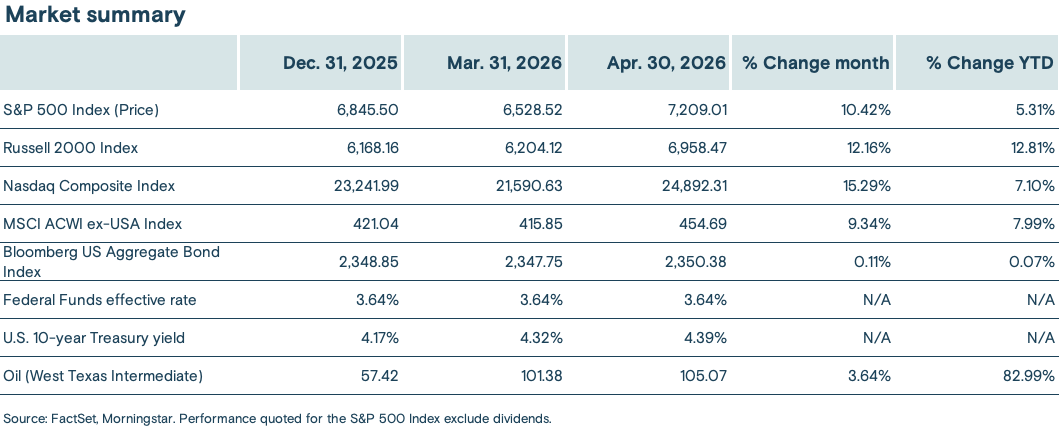
A chart summarizing the performance of select market indexes, the Federal Funds effective rate, 10-year T bonds, and oil.

What mattered in April

The economy: Economic data released in April was broadly supportive, with first-quarter gross domestic product (GDP) rebounding, strong corporate earnings, significantly falling jobless claims and stable retail sales. But consumer confidence continued to slide, oil prices remained high and inflation continued to climb, particularly among measures that include the more volatile food and energy sectors.

Stocks: Geopolitical uncertainty took a back seat to strong corporate earnings growth in April, with approximately 84% of reporting companies beating consensus expectations, resulting in the largest monthly rise (up 10.42%) in the S&P 500® Index since the COVID-19 vaccine was launched in November 2020. The Magnificent Seven accounted for nearly half of the S&P 500 Index’s monthly gain, the Nasdaq Composite Index surged 15.29% and the Russell 2000 Index of small-cap stocks rose 12.16%, outperforming the S&P 500 Index and signaling broader enthusiasm for equities.

Bonds: Benchmark 10-year Treasury yields rose modestly in April, and shorter-dated Treasury yields rose as market expectations for further interest-rate cuts in 2026 were effectively eliminated. The U.S. Federal Reserve (Fed) kept interest rates unchanged at its April meeting but revealed disagreement over the appropriate level for interest rates amid rising inflation and relatively stable employment. The Bloomberg U.S. Aggregate Bond Index, which is predominantly comprised of Treasuries, investment-grade corporate bonds and U.S. mortgage-backed securities, rose 0.11% in April.

How it changes our outlook:

The economy: Economic data has been encouraging, and we expect the economy to continue to find support from strong corporate earnings, a relatively low unemployment rate, resilient consumers, tax cuts, deregulation and an expansionary fiscal policy. But we believe the stability of the labor market and contained inflation are key to the economy’s success in 2026. To the extent that both employment and inflation are at risk due to geopolitical uncertainty, it suggests the pace of economic growth remains in some measure beholden to the outcome of the current conflict.

Our base case remains that growth will remain solid, propelled in part by a surge of capital spending on artificial intelligence (AI).

Stocks: We are modestly overweight equities versus fixed income based on our positive long-term outlook and emphasis on fundamentals and earnings. However, the potential for renewed periods of uncertainty and volatility arising from the conflict in the Middle East warrants some caution.

Maintain exposure, favoring an overweight to large-cap stocks and a moderate overweight to mid-cap stocks. We also have a modest overweight to small caps that includes private equity exposure along with a slight underweight to public small-cap stocks.

Bonds: The conflict in the Middle East can pressure interest rates in opposite directions. Higher oil prices can fuel inflation and send Treasury rates higher. At the same time, a sustained increase in oil prices could eventually dampen consumer spending and the economy, pressuring rates lower. As such, we are moderately overweight interest-rate exposure (duration) mainly through the long end of the Treasury rate curve as a hedge should the economy slow due to rising energy costs. Also, we favor higher-quality corporate bonds.

Maintain exposure to Treasuries and favor higher-quality corporate bonds with less exposure to macroeconomic weakness.

April’s key economic data

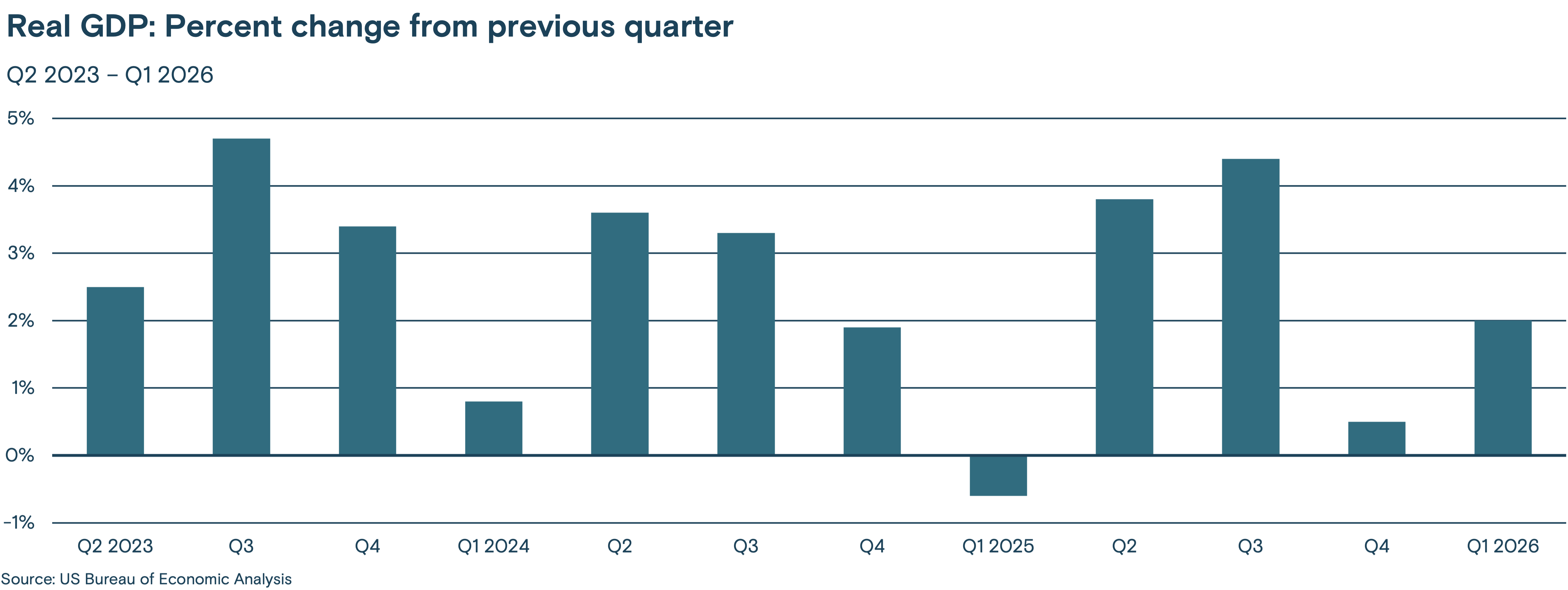
GDP rebounded from a 0.5% annualized growth rate in the fourth quarter of 2025 to an estimated 2.0% rate in the first quarter of 2026, which was moderately below expectations. Growth was fueled by robust business investment and consumer demand. Industrial production fell in March by 0.5%, below consensus expectations for a 0.1% rise, largely due to lower utility output with warmer than normal weather across much of the U.S. 

This bar chart shows the real GDP percent change from Q1 2023 to Q1 2026.


Consumer confidence keeps falling

The University of Michigan Consumer Sentiment Index fell in April to 49.8 from 53.3 in March, its weakest reading on record as middle- and moderate-income households struggle with rising inflation, particularly in fuel prices. Despite low confidence, retail sales increased in March, with total purchases rising 1.7% from February, fueled by a record increase in gasoline spending. Excluding gasoline purchases, the index rose 0.6%, near February’s revised 0.7% gain.

Employment data surprised

Applications for U.S. unemployment benefits plunged by 26,000 to 189,000 in the week ending April 26, well below consensus expectations and their lowest level since 1969. Continuing claims, which measure the number of people currently receiving unemployment benefits, also dropped to 1.79 million, its lowest level in the past few years.

Inflation accelerated

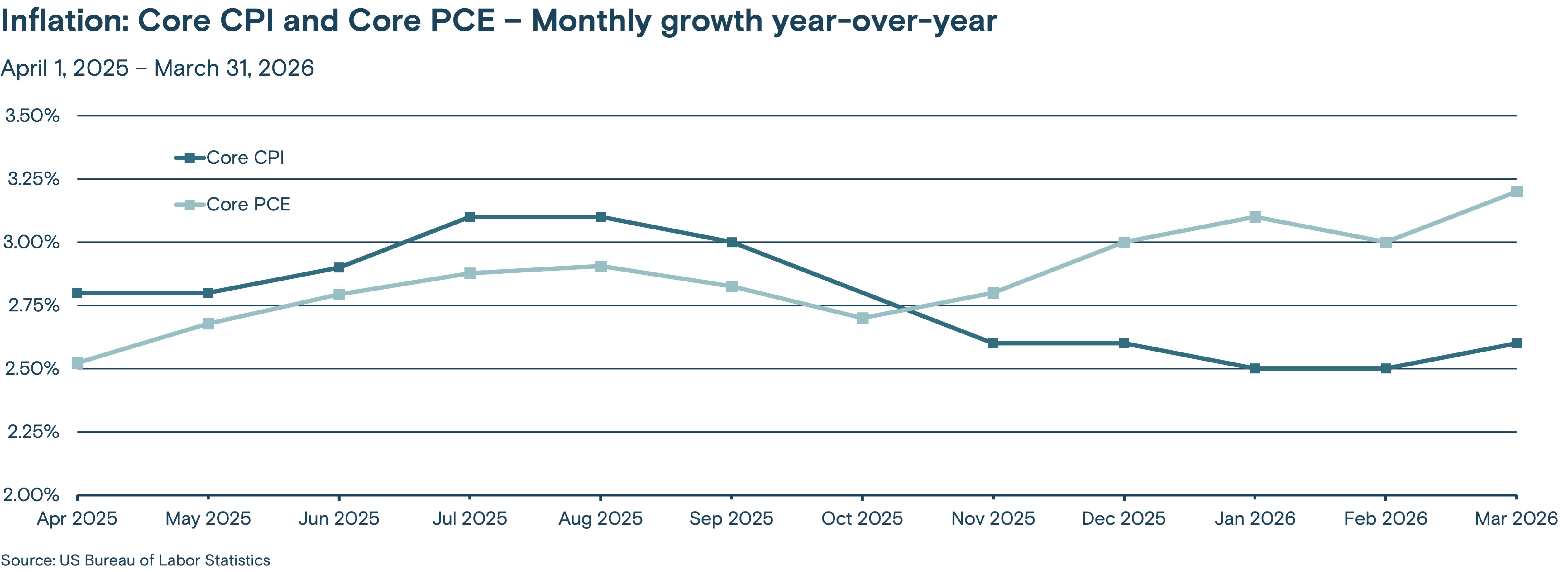
March’s Core Consumer Price Index (CPI) rose 2.6% from March of last year, while headline CPI (which includes the more volatile food and energy sectors) rose 3.3%, its largest rise since 2024, as energy prices rose. March’s Core Personal Consumption Expenditures (PCE) Price Index, which is the Fed’s preferred measure of inflation, continued to climb, rising 0.3% relative to February and 3.2% relative to March 2025. While the PCE figures were generally in line with expectations, Core PCE is now at its highest level since November 2023.

This line graph tracks the monthly year-over-year growth of the Core CPI (Consumer Price Index) and Core PCE (Personal Consumption Expenditures) from February 2025 through January 2026.

How key markets responded

U.S. stocks surged

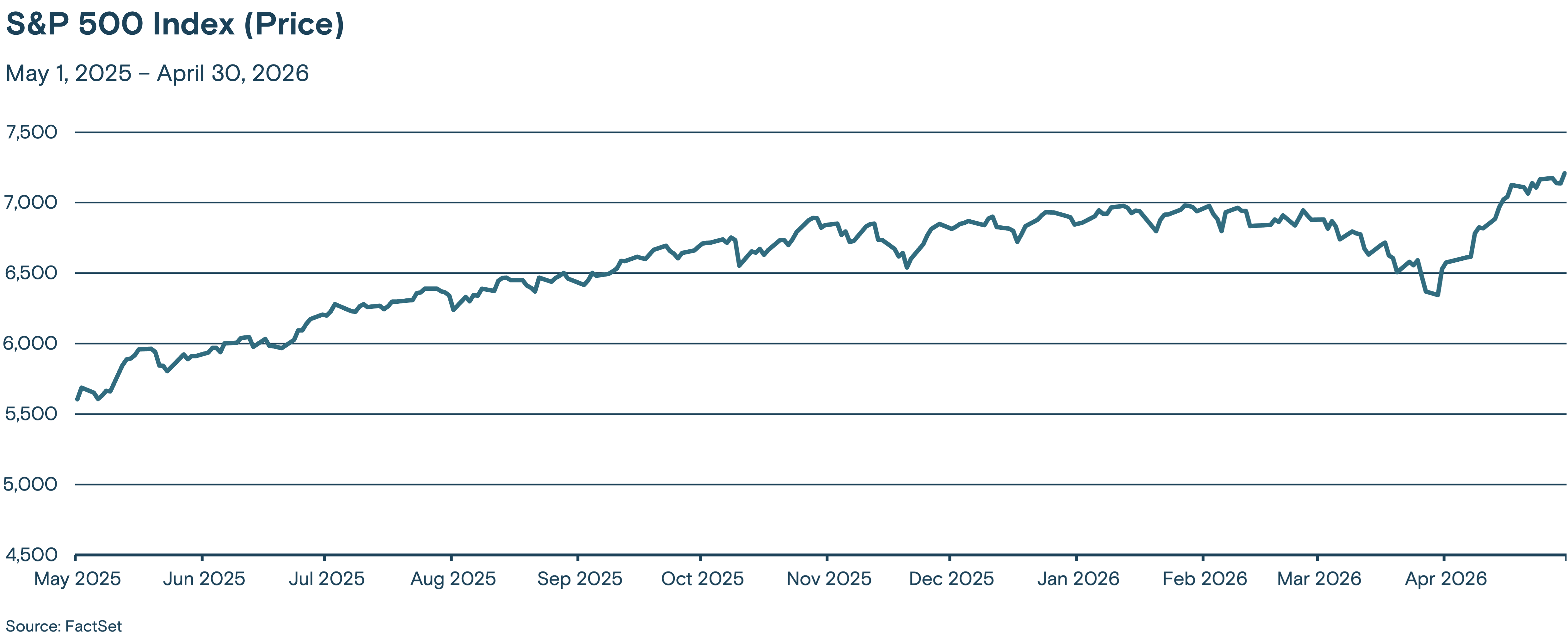
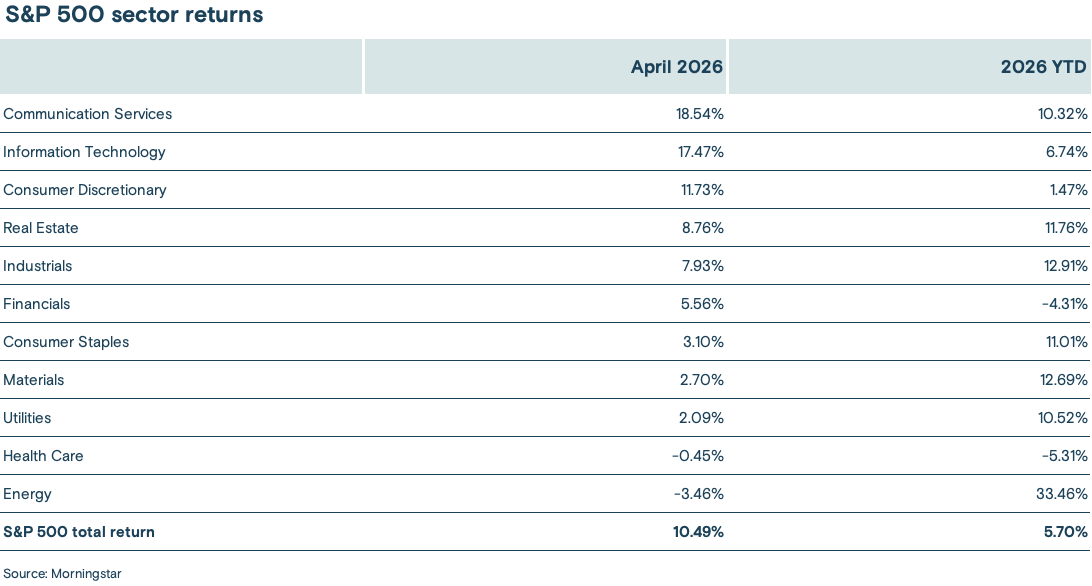
The S&P 500 Index of large-cap stocks rose 10.42% in April, its best month since November 2020. The strong performance was largely due to robust earnings, particularly from technology companies, which encouraged investors to focus more on corporate fundamentals and economic growth than on geopolitical concerns. Gains were led by a rebound in communications services (up 18.54%) and information technology (up 17.47%), while the tech-heavy Nasdaq Composite Index rose 15.29% over the period. The Russell 2000 Index of small-cap stocks rose 12.16%, again led by enthusiasm for technology companies. The energy sector, which was the worst performing sector in the S&P 500 Index, fell 3.46% in April but remains the strongest performing sector year to date, up 33.46%.

Line graph showing the trend of the S&P 500 Index from May 2025 through April 2026.


The table below shows the past month and year-to-date performance results of the 11 sectors:

Chart depicting the April 2026 and year-to-date returns of 11 S&P 500 sectors.


International equities marginally underperformed

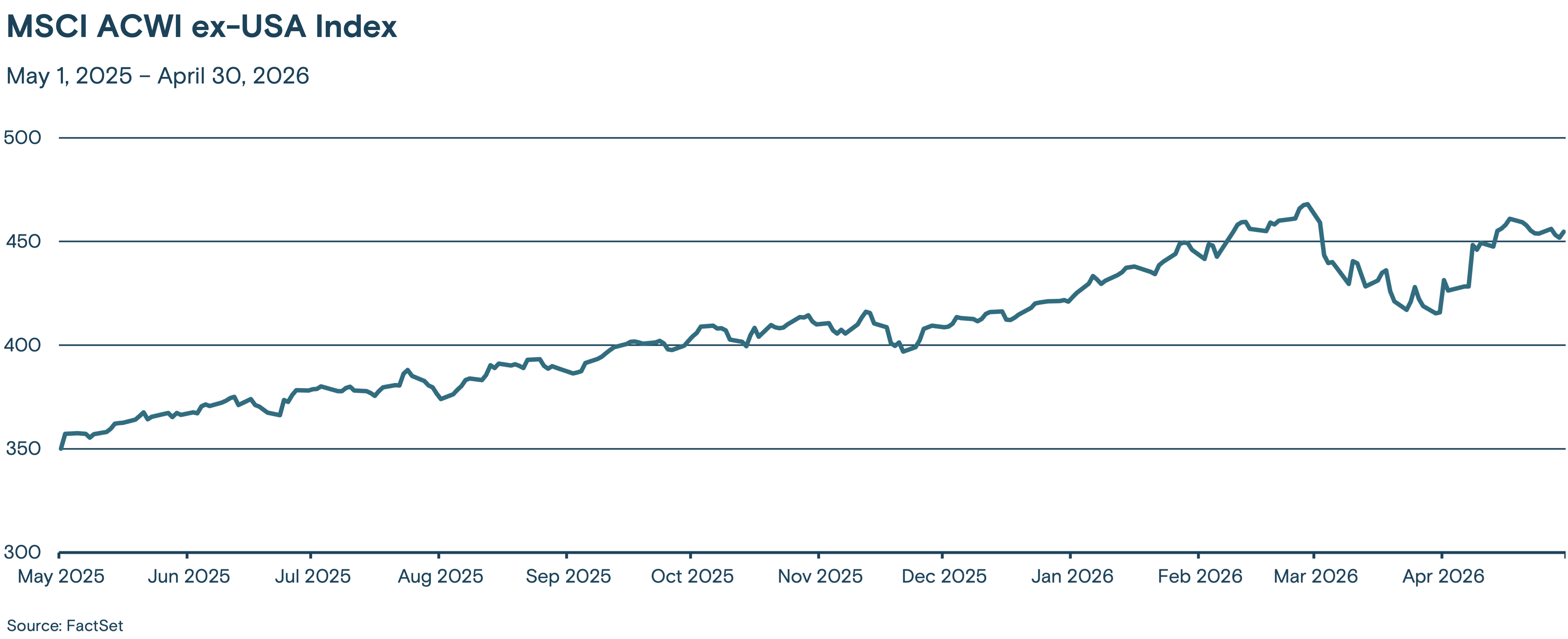
The MSCI ACWI ex-USA Index, which tracks stocks across developed and emerging-market economies across the world (excluding the U.S.), rose 9.34% in April, marginally underperforming the S&P 500 Index. Emerging-market countries led the index higher, driven by Taiwan and South Korea, which benefited from their significant role in the semiconductor supply chain. Developed countries such as Japan (up 6.6%) and within Europe (up 5.7%, not including the UK) saw more modest performance relative to the U.S., largely due to less technology-heavy indices.

This line graph tracks the MSCI ACWI ex-USA Index from May 2025 through April 2026.

Benchmark Treasury yields rose modestly

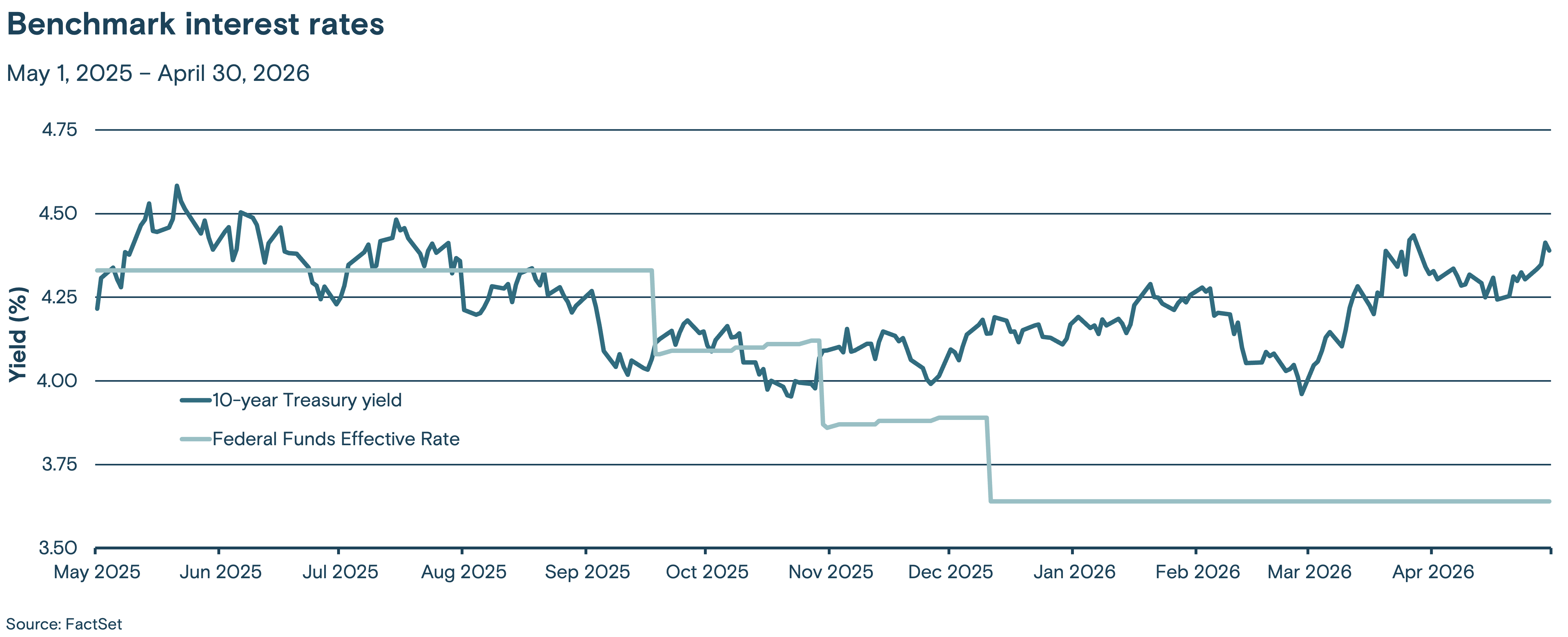
Benchmark 10-year Treasury yields climbed to 4.17% in April, a rise of 0.07% from the end of March. While the monthly rise was relatively modest, concerns about higher energy prices and higher inflation weighed on Treasury bond prices, pushing their yields higher. Additionally, the Fed's decision to hold interest rates steady on April 30 pushed yields higher across the Treasury yield curve. While investors largely priced out any chance of further interest-rate cuts in 2026, dissenting votes within the Federal Open Market Committee (FOMC), which sets interest rates, raised concerns that higher inflation and a more stable labor market could result in higher policy rates.

This line graph tracks two benchmark interest rates, the Federal Funds effective rate and the 10-year Treasury yield, from May 2025 through April 2026.

Investment-grade credit strengthened

Investment-grade corporate bond yield spreads (the amount of yield paid over comparable U.S. Treasuries) tightened in April as overall market sentiment improved, pushing equity, investment-grade and high-yield corporate bond prices higher. The Bloomberg U.S. Aggregate Bond Index rose 0.11% in April, bringing its year-to-date return to 0.07%.

U.S. dollar declined

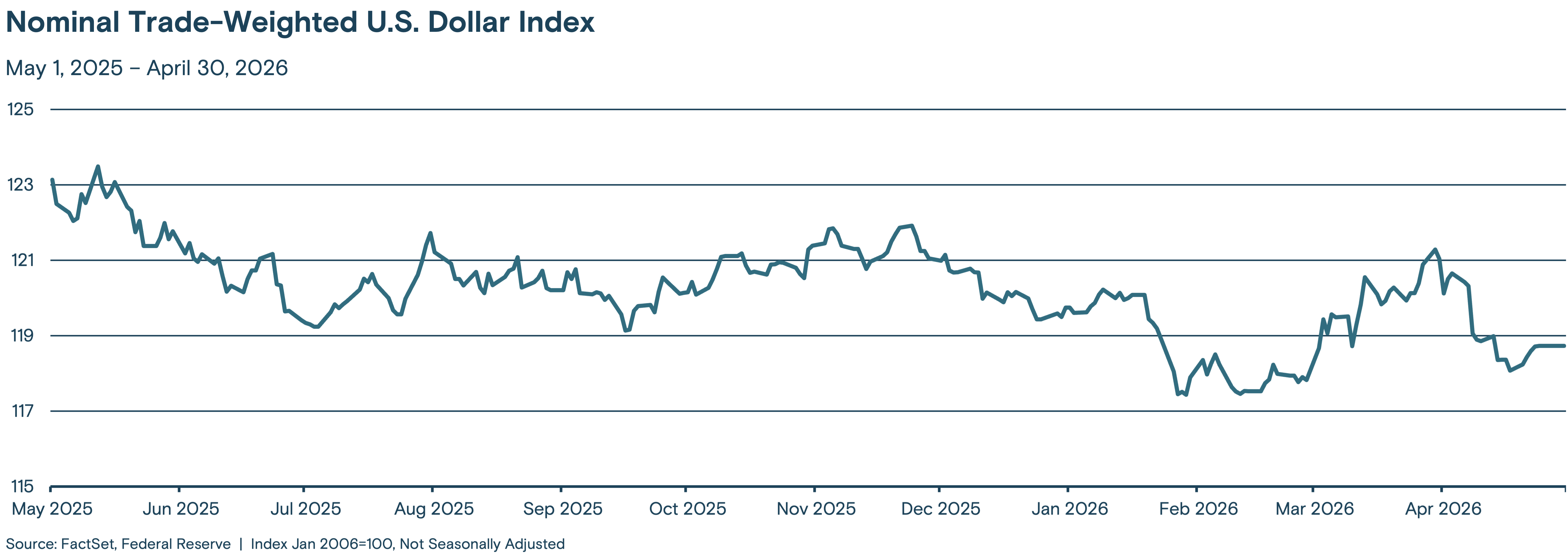
The Nominal Trade-Weighted U.S. Dollar Index fell 1.90% in April, its worst monthly performance in nearly a year. Weakness in the U.S. dollar was largely driven by optimism for a decline in hostilities in the Middle East, allowing investors to unwind their earlier purchases of the safe-haven currency. Additionally, Japan’s intervention to support the yen weighed on the U.S. dollar, as did strength in G10 currencies where inflation has been rising faster, raising expectations of higher interest rates. 

This line graph tracks the index value from May 2025 through April 2026.

Commodity prices rose

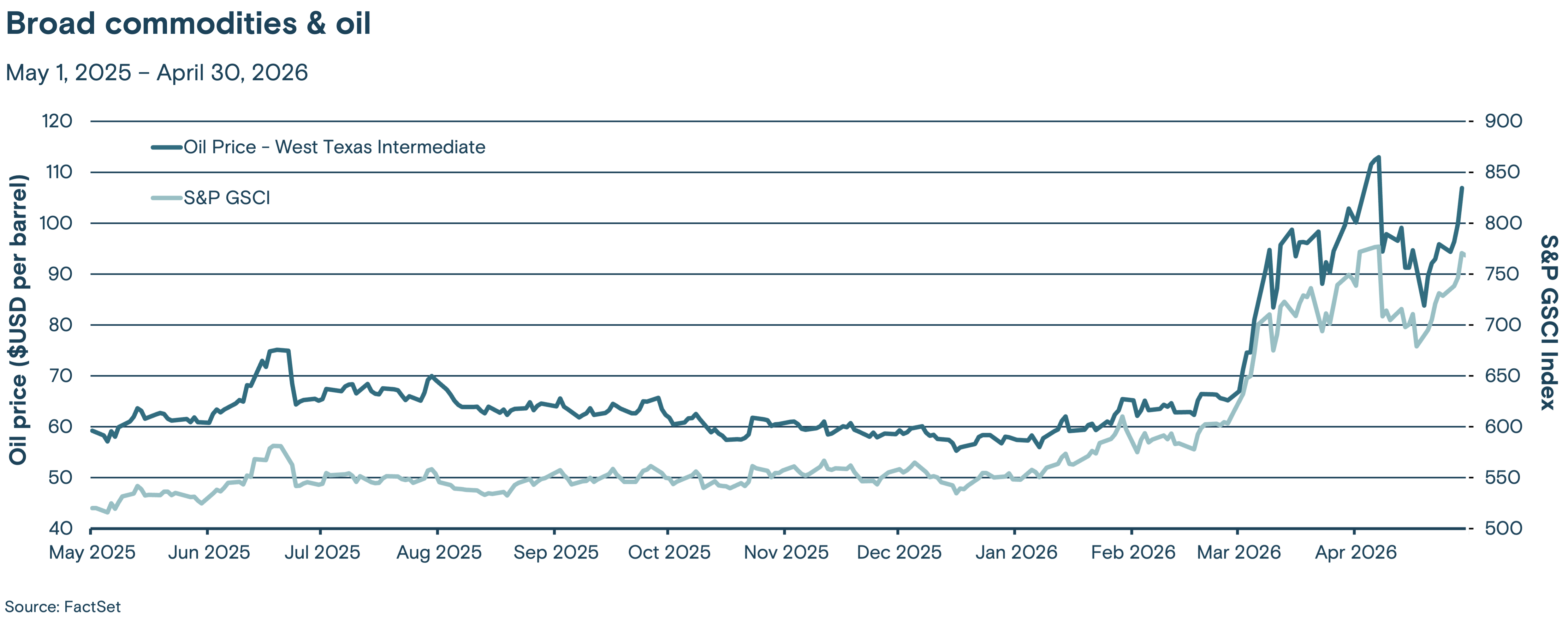
The S&P GSCI Index (a broad-based and production-weighted index representing the global commodity market) rose 3.12% in April, led by higher oil and industrial metal prices. The cost of a barrel of West Texas Intermediate (a grade of crude oil used as a benchmark in oil pricing) rose 3.64% over the month to $105.07 on fears of a protracted disruption in supply. Industrial metals rose as demand continued to rise, particularly for the development of AI data centers.

This line graph tracks the price of West Texas Intermediate crude oil and the S&P GSCI commodity index from May 2025 through April 2026.


Before making a change in your investment portfolio, you may wish to consult with a financial professional to determine how that may align with your long-term goals and objectives.


Media contact: Callie Briese, 612-844-7340; callie.briese@thrivent.com

All information and representations herein are as of 05/07/2026, unless otherwise noted.

The views expressed are as of the date given, may change as market or other conditions change, and may differ from views expressed by other Thrivent Asset Management, LLC associates. Actual investment decisions made by Thrivent Asset Management, LLC will not necessarily reflect the views expressed. This information should not be considered investment advice or a recommendation of any particular security, strategy or product. Investment decisions should always be made based on an investor's specific financial needs, objectives, goals, time horizon, and risk tolerance.

Duration is a measure of the sensitivity of the price of a bond or other debt instrument to a change in interest rates.

The S&P 500® Index is a market-cap weighted index that represents the average performance of a group of 500 large-capitalization stocks.

The Russell 2000® Index is an unmanaged index considered representative of small-cap stocks.

The Nasdaq Composite Index is a stock market index that includes almost all stocks listed on the Nasdaq stock exchange. The Nasdaq – National Association of Securities Dealers Automated Quotations – is an electronic stock exchange with more than 3,300 company listings.

The MSCI ACWI ex-USA Index is an unmanaged index considered representative of large- and mid-cap stocks across developed and emerging markets, excluding the U.S.

The Bloomberg U.S. Aggregate Bond Index is an unmanaged index considered representative of the U.S. investment-grade, fixed-rate bond market.

The Federal Funds effective rate is the interest rate at which depository institutions (mainly banks) lend reserve balances to other depository institutions overnight on an uncollateralized basis. In simpler terms, it's the rate banks charge each other for short-term loans to meet their reserve requirements.

The University of Michigan Consumer Sentiment Index is a consumer confidence index published monthly by the University of Michigan.

The Consumer Price Index measures the monthly change in prices paid by U.S. consumers for a basket of goods and services.

The Core Consumer Price Index (CPI) measures changes in the prices of goods and services, with the exclusion of food and energy.

The Personal Consumption Expenditures (PCE) Price Index, also known as consumer spending, is a measure of the spending on goods and services by people of the U.S.

The Core Personal Consumption Expenditures (PCE) Price Index, also known as consumer spending, is a measure of the spending on goods and services, excluding food and energy prices, by people of the U.S.

The Nominal Trade-weighted U.S. Dollar Index measures the value of the U.S. dollar based on its competitiveness versus trading partners.

G10 currencies refers to a group of ten major currencies used in global finance. The currencies are known for their liquidity and stability in the foreign exchange market. The currencies include the U.S. dollar (USD), euro (EUR), Japanese yen (JPY), British pound (GBP), Swiss franc (CHF), Canadian dollar (CAD), Australian dollar (AUD), New Zealand dollar (NZD), Norwegian krone (NOK), and Swedish krona (SEK).

Any indexes shown are unmanaged and do not reflect the typical costs of investing. Investors cannot invest directly in an index.

Past performance is not necessarily indicative of future results.

Related Insights