Interest rates are one of the most influential forces shaping financial markets. When rates rise—often in response to inflation or strong economic growth—the impact ripples the entire economic market. For investors, the challenge isn’t predicting rate moves, but positioning portfolios to manage risk while seeking to capture new opportunities.
Understanding the shift
Rising interest rates increase borrowing costs for companies of all sizes. Higher rates reduce the present value of future cash flows, which can pressure asset prices—particularly those dependent on long-term growth projections.
At the same time, higher rates may improve yields on cash and fixed-income instruments, creating new sources of potential income that are traditionally absent during a low-rate era. Because of these market shifts, rising interest rates may signal the need for a shift in investments.
Fixed income investments: focus on duration and flexibility
Bond markets are directly affected by rising rates. As rates increase, existing bond prices fall because newer bonds offer higher yields.
To manage this risk, investors often reposition their fixed-income exposure:
- Shorten duration: Short-term bonds are less sensitive to rate increases and help preserve capital.
- Use bond laddering: Staggering the timing of maturities allows reinvestment at higher yields over time.
- Pursue higher quality: Investment-grade and securitized bonds tend to offer investors less credit risk while earning higher yields when rates increase.
- Consider floating-rate or Treasury inflation-protected securities (TIPS). Floating rate bond coupons periodically reset higher as interest rates rise, helping earnings keep pace with changing market conditions. And TIPS are Treasury bonds where the principal value adjusts based on changes happening in the Consumer Price Index (CPI), therefore the bond’s value increases as inflation rises.
Also consider U.S. Treasury securities, which now provide higher income than in the recent past. For example, the widely tracked U.S. Treasury note with a 10-yr maturity now yields 5.01% vs. 4.11% one year ago1. Treasury securities may be considered lower risk, as their coupon payments (interest) and face value (principal value that is paid at a bond’s maturity date) are backed by the full faith and credit of the government.
Treasury bonds do have interest rate risk, however, and their prices will fluctuate based on multiple factors, including what the Fed does with short-term policy rates and investors’ expectations about the future path of inflation. It is generally true that bond prices will move inversely to interest rates, which can create challenges as rates rise.
The key is not abandoning fixed income, but optimizing it for a higher-rate environment where income opportunities may be improving.
Equities: Rotate toward resilience and income
Rising rates tend to compress equity valuations, especially for growth stocks that rely heavily on future earnings.
In response, many investors shift toward:
- Value-oriented companies with stronger current earnings
- Dividend-paying stocks that provide income alongside growth
- High-quality businesses with strong balance sheets and pricing power
Before making changes, investors should consider their risk tolerances and long term investing plans to ensure changes continue to reflect their goals.
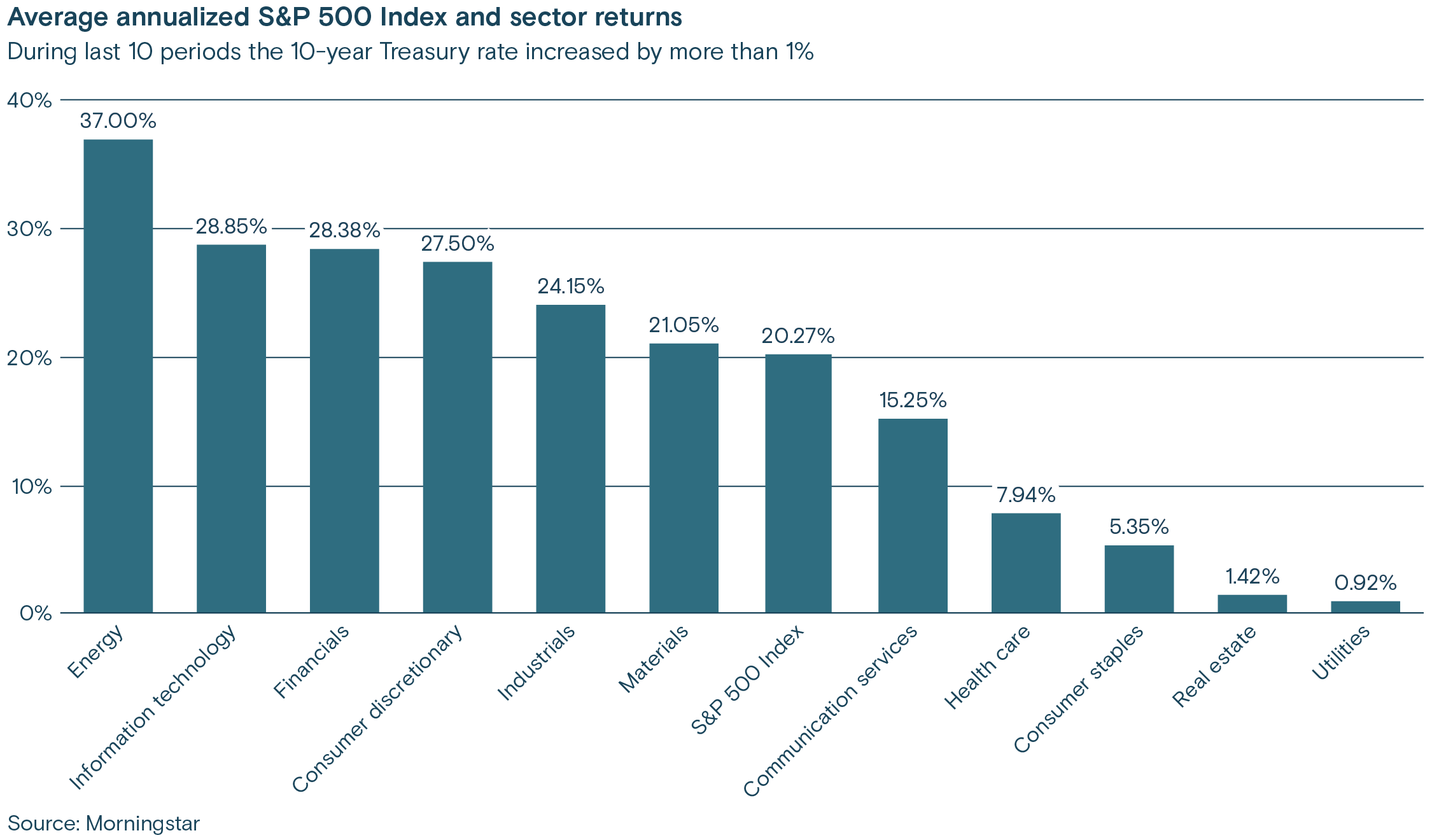
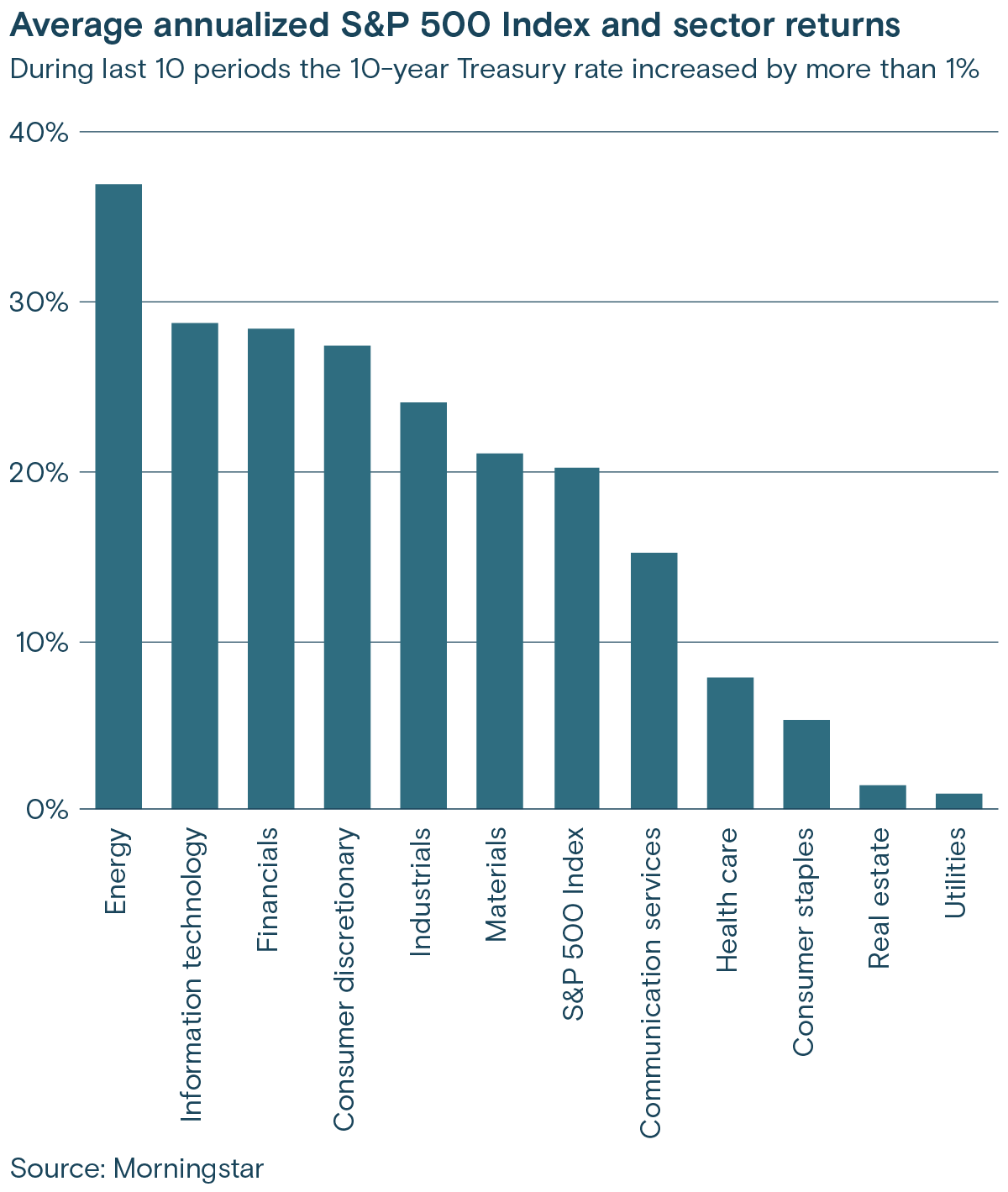
Sector positioning becomes especially important. Historically, certain sectors showed relative strength when rates rise, while others often lag:
- Energy, industrials and materials often benefited because they were closely tied to economic growth, inflation and higher commodity prices
- Financials may have seen improved lending profitability when interest rates moved higher
- Utilities, real estate, consumer staples and health care tended to lag as higher bond yields in other fixed income sectors increased competition for investor capital
Rather than exiting equities, the focus shifts to quality, profitability and resilience. In the below chart, returns are total annualized returns, including dividends.